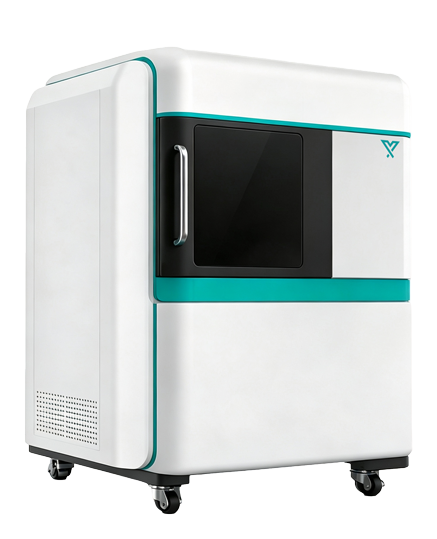
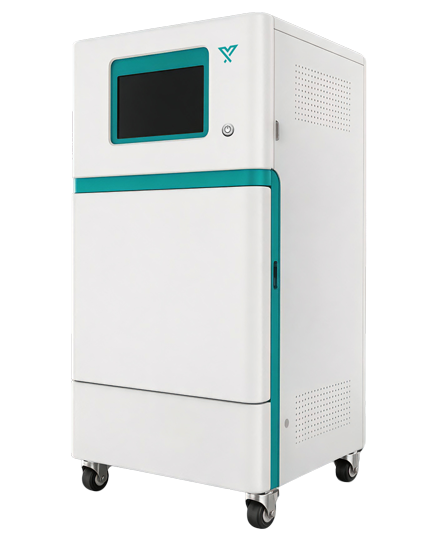
1. Visible‑light / NIR‑I: High‑Resolution Scientific‑Grade Cooled Camera
Fitted with an approximately 6‑megapixel, 16‑bit scientific‑grade cooled camera, covering a spectral range of about 400‑900 nm. Deep cooling combined with a large‑aperture lens balances faint‑signal detection for BLI and high‑resolution fluorescence imaging.
2. NIR‑II InGaAs Camera
Equipped with a 640 × 512 cooled InGaAs detector covering approximately 900‑1700 nm. It enables real‑time dynamic imaging as well as long‑exposure acquisition for low‑concentration probes.
3. Visible‑Light Fluorescence Excitation Module
Features 20 monochromatic LED light sources across 24 excitation positions, together with up to 18 narrow‑band emission filters of various wavelengths covering visible light to NIR‑I, enabling fluorescence signal detection for diverse fluorescent proteins and fluorescent probe labels. Light intensity and imaging channels can be automatically invoked by software to minimize manual adjustments.
4. NIR‑II Laser Excitation Module
Configured with 808 nm and 980 nm near‑infrared excitation sources with adjustable output power. The homogenizing optical path improves excitation uniformity across the field‑of‑view, providing stable conditions for inter‑animal and inter‑time‑point comparisons.
5. Full‑Spectrum Filter System
The visible‑light channel adopts a 24‑position emission filter wheel with narrow‑band filters. The NIR‑II channel uses a 6‑position emission filter wheel with multiple long‑pass filters in the 1000‑1500 nm range, for comparison of tissue penetration, scattering and signal‑to‑background ratio under different wavebands.
6. Dual‑Mode Imaging Stage
The stage is compatible with both visible‑light and NIR‑II optical paths. The visible‑light mode supports high‑throughput imaging of multiple animals, while the NIR‑II mode optimizes optical path and spatial resolution for smaller fields‑of‑view.
7. Animal Temperature‑Control and Anesthesia System
The temperature‑controlled stage, multi‑channel anesthesia interfaces and waste‑gas recovery module maintain stable animal conditions during static imaging and dynamic vascular observation.
8. Full‑Spectrum Analysis Software
One unified software platform performs data acquisition, management and analysis for different cameras and wavebands. It supports real‑time video, time‑intensity curves, vascular contour extraction, ROI quantification, signal‑to‑background ratio calculation and cross‑band image comparison.